Are you planning a vacation to foreign shores? A long weekend relaxing on a the beaches of Cancun or taking romantic strolls through Paris? Has it been a while since you studied a French or Spanish in high school? Or maybe you're just starting your studies in German or Japanese?
Carnegie-Stout has a database that can help you out! Mango Languages offers interactive, introductory level language practice in 46 different languages. Anyone can access Mango from one of Carnegie-Stout's computers, or from your home if you have a full service library card.
To find Mango, go to the library's homepage: www.dubuque.lib.ia.us and click on the "Research Tools" link on the left-hand side of the screen. This brings you to an alphabetical list of our research databases from which you will be able to open Mango. If you are outside of the library, you will be prompted to enter the bar code from the back of your library card and your PIN (usually the last four numbers of your phone number).
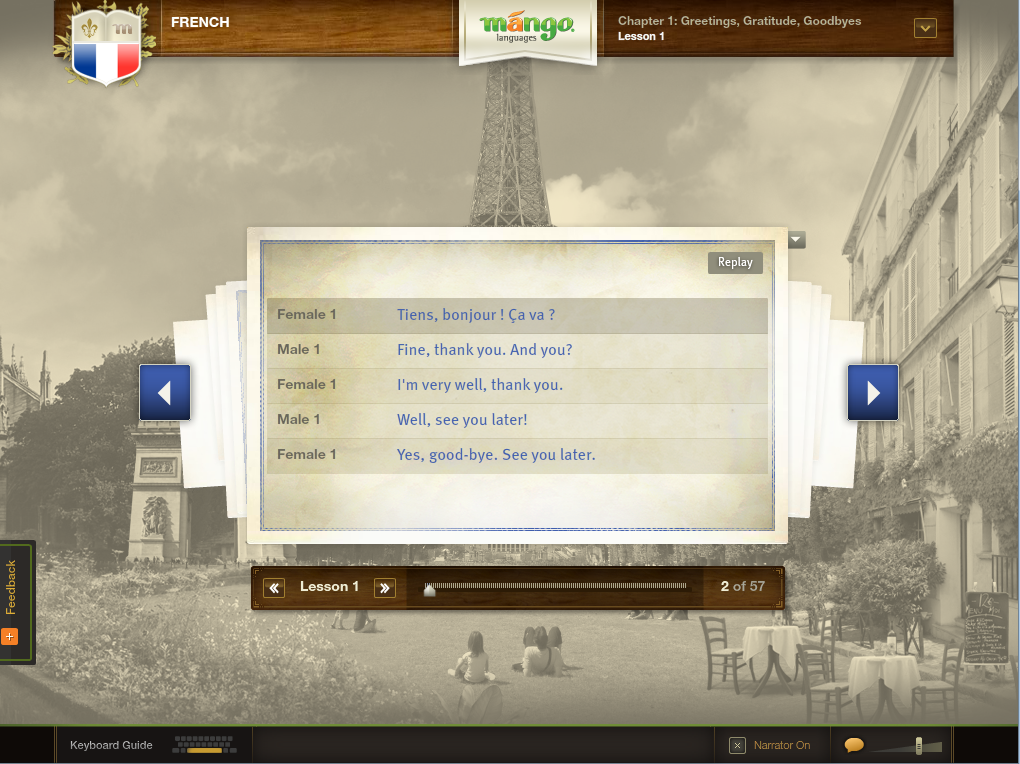
Once Mango loads, you'll be asked to Log In, Create a Profile, or Start Learning. (Note: you can enlarge the images by clicking on them)
You do not need to create a profile or log in to use Mango, but if you do, Mango will track your progress and allow you to pick up where you left off. To create a profile, simply register with an email address and the password of your choice.
Once you have selected Start Learning or logged in, you'll see a screen with all of the available language courses.
In addition to the 46 languages available, there are English courses for non-native speakers. These English courses are designed for people from 15 different language backgrounds. You can select the English courses from the left-hand side of the screen, or you can select the language of your choice from the list in the middle. For today's example, we'll be looking at French.
The French lesson offers some basic information about the language and where it is spoken, in addition to the three language levels: Basic, Complete 1.0, and Complete 2.0. Today we'll be looking at Basic. To start this level, push the button next to Basic which says "Launch." This will open a new window. (Note: you may need to update Adobe Flash Player)
Each level is split into Chapters, and the Chapters into Lessons. If you have created a profile and logged in, Mango will remind you which lessons you have already completed. Although you are more than welcome to repeat any portion you might like to revisit! We'll start with Chapter 1, Lesson 1; to start this lesson we click on the number one under Chapter 1.
Each Lesson starts with an overview of what topics will be covered, and what concepts we'll be learning. Each lesson will include conversations that teach you useful phrases, grammatical concepts, and vocabulary. The text will be shown in English and, in this case, French. You'll want to make sure you have your computer speakers turned on or your head phones plugged in so that you can hear the proper pronunciation. At the end of the lesson there will be questions to help you test your knowledge and review what you've learned.
You may've noticed that at the top of the screen there is an option which says "Translate." This will take you to a feature similar to Babelfish or Google Translate, where text typed in one box will be translated into the language of your choice in the next box. While these tools can be helpful, be warned that the translations are not always perfect.
If this isn't quite your speed or level, Carnegie-Stout does have a good collection of language learning materials in both print and CD Audio. You can find this material in our catalog by doing a subject search for: French language -- Self-instruction (or replace "French" with the language of your choice), or come in and browse the 400s! Or if you're planning a trip, most of our travel guidebooks can be found between 910 and 917 (you might also want to check the DVDs).
Et nous vous souhaitons bon voyage!
Friday, August 31, 2012
Thursday, August 30, 2012
"Personal Sketches of the Civil War" presentation now on YouTube
Did you miss local historian John Pregler's presentation on Dubuque's
Civil War history? You can watch the whole thing on YouTube! We've also
got dvd and blu-ray copies that will be available for checkout soon. If you can't wait, the speech will also begin to air on Dubuque's Channel 8 on Labor Day at 8 p.m.
Tuesday, August 28, 2012
Best Seller Read-Alikes for the Week of August 26th
Can’t wait to get your hands on the latest best-seller, but the
hold list is too long? To tide you over, every week we’ll offer similar
titles and authors to the week’s fiction and nonfiction best sellers.
Fiction
Gone Girl by Gillian Flynn is once again #1 on the best sellers list. Sarah wrote a great read-alike for Flynn, which you can find here. At #2 and striking a far different note is Debbie Macomber's latest, The Inn at Rose Harbor. A spin-off of her popular Cedar Cove novels, is set in the same small town, but focused on a youngish widow named Jo Marie Rose who has purchased the bed-and-breakfast of the title. Her first guests, Abby and Josh, bring with them their own troubles and, as their stories intertwine, both the guests and Jo Marie are given hopeful new beginnings.
Authors similar to Debbie Macomber include:
Click here for more fiction bestsellers...
Nonfiction
Marking its 92nd week on the best sellers list, Laura Hillenbrand's Unbroken: A World War II Story of Survival, Resilience and Redemption is back at number one, and you can find read-alikes for that title here. At number two is The Amateur: Barack Obama in the White House by Edward Klein and you can find read-alike here. At number three is a memoir by Hope Solo, the goalkeeper for the U.S. women's soccer team, Solo: A Memoir of Hope. Solo reveals how she has repeatedly triumphed over adversity, from her childhood in Richland, Washington, to the realization of her dreams of being a world-class soccer player.
Other books similar to Solo include:
In the Water They Can't See You Cry: A Memoir by Amanda Beard (Biog. Beard) - Seven-time Olympic medalist Amanda Beard describes her battles with depression, eating disorders, and substance abuse in spite of her successful career, recounting how she hid her struggles from her loved ones before seeking help and finding renewal in the birth of her son.
The Glass Castle by Jeannette Walls (Biog. Walls) - The child of an alcoholic father and an eccentric artist mother discusses her family's nomadic upbringing, during which she and her siblings fended for themselves while their parents outmaneuvered bill collectors and the authorities.
Click here for more nonfiction bestsellers ...
If you'd like more recommendations, stop by the Recommendations Desk on the first floor, check out NoveList Plus on the library's website, or visit W. 11th & Bluff next week for more reading suggestions. Or submit a Personal Recommendations request, and we'll create a reading list just for you!
Fiction
Gone Girl by Gillian Flynn is once again #1 on the best sellers list. Sarah wrote a great read-alike for Flynn, which you can find here. At #2 and striking a far different note is Debbie Macomber's latest, The Inn at Rose Harbor. A spin-off of her popular Cedar Cove novels, is set in the same small town, but focused on a youngish widow named Jo Marie Rose who has purchased the bed-and-breakfast of the title. Her first guests, Abby and Josh, bring with them their own troubles and, as their stories intertwine, both the guests and Jo Marie are given hopeful new beginnings.Authors similar to Debbie Macomber include:
Jan Karon's Mitford series,
has a strong inspirational message. In a small town setting, Karon
explores her characters' lives with humor and grace, and offers
emotionally satisfying solutions as well as domestic pleasures and
endearing characters. The series begins with At Home in Mitford, which introduces Episcopalian Father Timothy Kavanaugh, his congregation, and his comical dog.
Robyn Carr writes contemporary romances and love stories that are character driven. Her stories are bittersweet, heartwarming and dramatic. Start with Virgin River, the first in her Virgin River series. Arriving
in the remote mountain town of Virgin River in response to an ad,
recently widowed Melinda realizes that she has made a mistake, until she
finds an abandoned baby on her porch and lets a former Marine into her
heart.
Click here for more fiction bestsellers...
Nonfiction
Marking its 92nd week on the best sellers list, Laura Hillenbrand's Unbroken: A World War II Story of Survival, Resilience and Redemption is back at number one, and you can find read-alikes for that title here. At number two is The Amateur: Barack Obama in the White House by Edward Klein and you can find read-alike here. At number three is a memoir by Hope Solo, the goalkeeper for the U.S. women's soccer team, Solo: A Memoir of Hope. Solo reveals how she has repeatedly triumphed over adversity, from her childhood in Richland, Washington, to the realization of her dreams of being a world-class soccer player.Other books similar to Solo include:
In the Water They Can't See You Cry: A Memoir by Amanda Beard (Biog. Beard) - Seven-time Olympic medalist Amanda Beard describes her battles with depression, eating disorders, and substance abuse in spite of her successful career, recounting how she hid her struggles from her loved ones before seeking help and finding renewal in the birth of her son.
The Glass Castle by Jeannette Walls (Biog. Walls) - The child of an alcoholic father and an eccentric artist mother discusses her family's nomadic upbringing, during which she and her siblings fended for themselves while their parents outmaneuvered bill collectors and the authorities.
Click here for more nonfiction bestsellers ...
If you'd like more recommendations, stop by the Recommendations Desk on the first floor, check out NoveList Plus on the library's website, or visit W. 11th & Bluff next week for more reading suggestions. Or submit a Personal Recommendations request, and we'll create a reading list just for you!
Monday, August 27, 2012
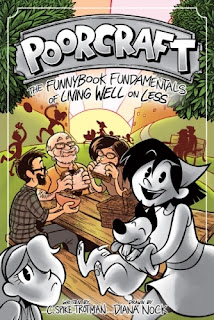
Poorcraft by C. Spike Trotman & Diana Nock
Around the age of seven, I decided that books with pictures were for little kids who couldn't read real books yet, or boys who liked robot trucks and superheroes so much that cartoons weren't enough. The only exceptions to this rule were Garfield, The Far Side, and Calvin and Hobbes.
Luckily, by the time I got to college, dorm rooms came equipped with internet and in between working on papers I discovered webcomics. Almost always free, often created by newer, less established, or more experimental artists and writers, these were my one-page-at-a-time introduction to the world of graphic novels.
I'm still an avid reader of webcomics, which is how I came to hear of Poorcraft: funnybook fundamentals of living well on less (640 TRO). The writer, Spike Trotman, is responsible for one of my favorites, Templar, AZ (sometimes NSFW), and I've been waiting to read this graphic novel guide to living within your means since she raised the possibility.
In fact, I wish I'd had this book before I finished college, and entered the world of entry level positions, job hunting in a lukewarm economy, and graduate school. Poorcraft has everything from tips on how to make your own cleaning supplies to how to navigate the complexity of the health care system. Some of the advice my parents gave me (always keep a budget, don't buy things on credit), and some I've learned through experience (how to find a good apartment), but many elements were new for me (how to care for an iron skillet).
The art is done by Diana Nock who, among other projects, does the webcomic The Intrepid Girlbot (family friendly). The style she uses for Poorcraft reminds me of cartoons from the 1930s, very expressive and loose limbed. A callback to the Great Depression makes sense for the topic! I love the humor of the visual style (there are some very amusing background elements), and how the book is organized around Millie's navigation of the concepts of frugality with Penny's help. By having the humor and a narrative, it turns Poorcraft from a list of Dos and Don'ts into a story you'll want to read cover to cover!
I highly recommend this title for anyone looking to save a little money in their budget, whether you're just starting out, or you've been navigating adulthood for years. Poorcraft will give you a good starting point!
You can see more of Spike's work on her website: www.ironcircus.com
And more of Diana Nock's work on her website: www.jinxville.com
Both sites may include material that is NSFW.
~Sarah, Adult Services
Luckily, by the time I got to college, dorm rooms came equipped with internet and in between working on papers I discovered webcomics. Almost always free, often created by newer, less established, or more experimental artists and writers, these were my one-page-at-a-time introduction to the world of graphic novels.
I'm still an avid reader of webcomics, which is how I came to hear of Poorcraft: funnybook fundamentals of living well on less (640 TRO). The writer, Spike Trotman, is responsible for one of my favorites, Templar, AZ (sometimes NSFW), and I've been waiting to read this graphic novel guide to living within your means since she raised the possibility.
In fact, I wish I'd had this book before I finished college, and entered the world of entry level positions, job hunting in a lukewarm economy, and graduate school. Poorcraft has everything from tips on how to make your own cleaning supplies to how to navigate the complexity of the health care system. Some of the advice my parents gave me (always keep a budget, don't buy things on credit), and some I've learned through experience (how to find a good apartment), but many elements were new for me (how to care for an iron skillet).
The art is done by Diana Nock who, among other projects, does the webcomic The Intrepid Girlbot (family friendly). The style she uses for Poorcraft reminds me of cartoons from the 1930s, very expressive and loose limbed. A callback to the Great Depression makes sense for the topic! I love the humor of the visual style (there are some very amusing background elements), and how the book is organized around Millie's navigation of the concepts of frugality with Penny's help. By having the humor and a narrative, it turns Poorcraft from a list of Dos and Don'ts into a story you'll want to read cover to cover!
I highly recommend this title for anyone looking to save a little money in their budget, whether you're just starting out, or you've been navigating adulthood for years. Poorcraft will give you a good starting point!
You can see more of Spike's work on her website: www.ironcircus.com
And more of Diana Nock's work on her website: www.jinxville.com
Both sites may include material that is NSFW.
~Sarah, Adult Services
Tags:
Advice,
Books,
cooking,
Finances,
FY13,
Garden,
Graphic Novels,
Health,
Links,
Poverty,
SarahElsewhere,
Staff Reviews
Friday, August 24, 2012
Read Alike: The Wettest County in the World
Shia LaBeouf's new movie, Lawless, is scheduled for release next week. The story tells of three brothers who make their living in the violent world of Prohibition era bootlegging. The plot is based on the Depression era ancestors of author Matt Bondurant. Mr. Bondurant used their story in his suspenseful 2008 novel, The Wettest County in the World.
When you add in the recent excitement around Western inspired novels, many of which have been adapted to the big screen in recent years, you wind up with today's list of reading suggestions.
For more on the Prohibition and the rise of organized crime during the Depression, check out Boardwalk Empire: the birth, high times, and corruption of Atlantic City by Nelson Johnson (974.985 JOH). This nonfiction title about the rise of Atlantic City and the powerful men behind the city served as the basis for the HBO drama of the same name.
No Country for Old Men by Cormac McCarthy
Mr. McCarthy is not a cheerful author. His menacing novels delve into the dark sides of humanity and our propensities for violence. He's known for setting his stories in the Southwest, whether in the lawless past, or the lawless future. No Country for Old Men is the story of Llewelyn Moss, who gets himself caught up in the violence of drug trafficking in the '80s. The 2007 film adaptation starring Tommy Lee Jones and Josh Brolin received the Academy Award for Best Picture.
True Grit by Charles Portis
In his career, Mr. Portis has been both a journalist and a novelist. In fact his second novel, True Grit, was originally serialized in The Saturday Evening Post. This engaging, suspenseful novel takes its cues from the Western genre, but creates something unique. A dialog-rich story told from the perspective of 14 year-old Mattie Ross, and her quest for revenge on the man who killed her father and the not quite upstanding men who join her in her quest. This novel has seen multiple film adaptations, from the 1969 version with John Wayne to the 2010 version, which also stars Josh Brolin.
Doc by Mary Doria Russell
Ms. Russell's most recent novel is, like her earlier works, richly detailed and character-driven, as she plays with genre conventions. Ms. Russell is known for experimenting with genre, often combining science fiction elements with historical settings. Doc is the story of the infamous Doc Holliday and how he came to meet up with Wyatt Earp in Dodge City, Kansas, though not the infamous shootout at the OK Corral. While there is no movie adaption for this title yet, rumor has it there might be an HBO series in the works.
The Sisters Brothers by Patrick deWitt
Mr. deWitt's second novel, The Sisters Brothers, has garnered quite a bit of positive attention, including winning The Morning News' 2012 Tournament of Books. It's a gritty and darkly comic novel of the California Gold Rush. Eli and Charlie Sisters, brothers and hired guns of fearsome reputation, are on a mission to kill Hermann Kermit Warm. Eli, the narrator, begins to question their violent life. While there is no movie yet, John C. Reilly's production company has purchased the film rights.
Readers who enjoy stories about living on the wrong side of the law in a lawless land should also check out Joyce Saricks' recent Booklist column on books with a Western inspiration. It's a creative field, whether you prefer something historical or fantastic, violent or less so. Which was your favorite, Deadwood or Firefly?
Please stop by the Recommendations Desk on the first floor, check out NoveList Plus on the library's website, or visit W. 11th & Bluff next week for more reading suggestions. Or submit a Personal Recommendations request, and we'll create a reading list just for you!
When you add in the recent excitement around Western inspired novels, many of which have been adapted to the big screen in recent years, you wind up with today's list of reading suggestions.
For more on the Prohibition and the rise of organized crime during the Depression, check out Boardwalk Empire: the birth, high times, and corruption of Atlantic City by Nelson Johnson (974.985 JOH). This nonfiction title about the rise of Atlantic City and the powerful men behind the city served as the basis for the HBO drama of the same name.
No Country for Old Men by Cormac McCarthy
Mr. McCarthy is not a cheerful author. His menacing novels delve into the dark sides of humanity and our propensities for violence. He's known for setting his stories in the Southwest, whether in the lawless past, or the lawless future. No Country for Old Men is the story of Llewelyn Moss, who gets himself caught up in the violence of drug trafficking in the '80s. The 2007 film adaptation starring Tommy Lee Jones and Josh Brolin received the Academy Award for Best Picture.
True Grit by Charles Portis
In his career, Mr. Portis has been both a journalist and a novelist. In fact his second novel, True Grit, was originally serialized in The Saturday Evening Post. This engaging, suspenseful novel takes its cues from the Western genre, but creates something unique. A dialog-rich story told from the perspective of 14 year-old Mattie Ross, and her quest for revenge on the man who killed her father and the not quite upstanding men who join her in her quest. This novel has seen multiple film adaptations, from the 1969 version with John Wayne to the 2010 version, which also stars Josh Brolin.
Doc by Mary Doria Russell
Ms. Russell's most recent novel is, like her earlier works, richly detailed and character-driven, as she plays with genre conventions. Ms. Russell is known for experimenting with genre, often combining science fiction elements with historical settings. Doc is the story of the infamous Doc Holliday and how he came to meet up with Wyatt Earp in Dodge City, Kansas, though not the infamous shootout at the OK Corral. While there is no movie adaption for this title yet, rumor has it there might be an HBO series in the works.
The Sisters Brothers by Patrick deWitt
Mr. deWitt's second novel, The Sisters Brothers, has garnered quite a bit of positive attention, including winning The Morning News' 2012 Tournament of Books. It's a gritty and darkly comic novel of the California Gold Rush. Eli and Charlie Sisters, brothers and hired guns of fearsome reputation, are on a mission to kill Hermann Kermit Warm. Eli, the narrator, begins to question their violent life. While there is no movie yet, John C. Reilly's production company has purchased the film rights.
Readers who enjoy stories about living on the wrong side of the law in a lawless land should also check out Joyce Saricks' recent Booklist column on books with a Western inspiration. It's a creative field, whether you prefer something historical or fantastic, violent or less so. Which was your favorite, Deadwood or Firefly?
Please stop by the Recommendations Desk on the first floor, check out NoveList Plus on the library's website, or visit W. 11th & Bluff next week for more reading suggestions. Or submit a Personal Recommendations request, and we'll create a reading list just for you!
Tags:
Books,
FY13,
History,
Movies,
Read Alikes,
SarahElsewhere,
Suspense,
Television,
True Crime,
Westerns
Tuesday, August 21, 2012
The Cold Dish by Craig Johnson
Over the summer there was a television show called Longmire
on A&E. When I saw the previews I
though it looked intriguing and if I’m totally honest I decided to watch it
because Katee Sackhoff (Starbuck, Battlestar Galactica) was one of the main
cast members. She has been connected to
a few shows after BSG ended but they didn’t make it past the first
season. The first episode didn’t wow me
but I gave it a second chance. I’m
hooked and now that the season is over I thought I should read at least one of
the books the series is based on. The
Longmire series by Craig Johnson starts with The Cold Dish and follows Walt Longmire, the Sheriff of the
fictional Absaroka County, Wyoming. This
is a police procedural but the pacing is much slower than a police procedural
that takes place in a big city. It is
easy to imagine that the daily life of Walt Longmire described in the book is
exactly what life is like for a county sheriff in Wyoming.
At the beginning of The
Cold Dish, Walt is introduced to us as an aging sheriff nearing
retirement. He spends his days staring
out his office window, looking over an old case file and drinking away his
nights. He is a widower and his
daughter, a lawyer, lives out East. When
he gets a call from a couple of hard drinking ranchers (apparently they are
never sober) who swear they found a body on their land, Walt passes the call
off to one of his deputies. Walt is a
good sheriff, but Walt doesn’t really want to work too hard these days. A few
years ago Walt investigated the gang rape of a young Cheyenne girl. The four boys involved didn’t get the
punishment they deserved and this is the case that haunts Walt to this
day. As a result there is a lot of tension
between Walt and those who live on the reservation. The dead body Walt did not want to
investigate turns out to be one of the boys who participated in the gang
rape. Now Walt is torn between seriously
investigating the murder and saying “good riddance to bad trash”. Walt’s best friend is Henry Standing Bear, owner
of the Red Pony bar, Vietnam vet (as is Walt) and well-respected member of the
Cheyenne Nation. Due to the strained
relationship between Walt and the tribal police, Henry’s help is essential to
Walt’s investigation. Henry also serves another purpose in the book. He has taken it upon himself to get Walt out of the depression he has been in since the death of his wife. Henry and Walt's daughter conspire to get Walt in shape and start dating.
As with any TV show based on a book there are
differences. The cast members never seem
to fit the physical description of the written characters. Also, some of the character names have been
changed but that certainly did not detract from my enjoyment of both the book
and the show. What the book provides is
character development and background information that the show was not able to
delve into in its short, 10 episode season.
Normally when a TV show is based on a book the first episode is taken
from the book plot. Longmire waited
until the last episode of the season to air a plot similar to The Cold
Dish. I enjoyed both the TV show and the
book but keep in mind if you are looking for a fast-paced thriller, this is not
the series for you.
~Amy, Adult Services
Friday, August 17, 2012
Spotlight: Political Mysteries
With the excitement of this week's visits to Iowa by Vice Presidential candidate Paul Ryan, and current President Barack Obama, there's no denying that the election is in full swing. The national conventions are coming soon too. The Republicans will convene in Florida from August 27th through the 30th. The Democrats will gather in North Carolina from September 4th through the 6th.
Carnegie-Stout has books for anyone who wants to learn more about the candidates. You can browse those lists in our catalog by clicking the link of your choosing:
Governor Mitt Romney
President Barack Obama
In poking around Presidential trivia recently, I discovered an interesting fact, not one, but two children of former Presidents had successful careers as mystery novelists: Elliott Roosevelt, son of President Franklin D. Roosevelt and Margaret Truman, daughter of President Harry S. Truman.
Both authors make use of their special connection to Washington politics to craft their mysteries, using real political figures and recognizable landmarks. Nor are they the only authors to mix politics and murder to craft a suspenseful tale.
Murder and the First Lady by Elliott Roosevelt
Mr. Roosevelt's mother, Eleanor Roosevelt, acts as the sleuth in his historical mystery series. His writing isn't overly violent, and readers will enjoy the historical details. Despite being set during the Depression and WWII, there is an optimism to this series, which starts with Murder and the First Lady.
Margaret Truman
Ms. Truman used a more contemporary Washington D.C. as the setting for her suspenseful mystery novels. Although characters make reappearances, readers can explore her books in any order. She keeps much of the violence off of the page, and provides readers with a twisting plot that will keep you guessing.
State of the Onion by Julie Hyzy
Ms. Hyzy is the author of several cozy mystery series filled with colorful characters. Her amateur sleuths tend to have interesting day jobs, but none so interesting as Olivia Paras, White House chef. The series starts with State of the Onion, Olivia is under enough stress as she competes for a promotion to Executive Chef before she stumbles into a plot to kill the President.
The Alienist by Caleb Carr
Mr. Carr's historical mysteries are somewhat more violent than the other authors on today's list, but readers who enjoy a fast-paced plot and a literary flare should give him a try. The Alienist, his atmospheric third novel, is set in 1896 New York City, and Police Commissioner Theodore Roosevelt is working to catch a serial killer.
James Lehrer, journalist, anchor, and author of fiction and nonfiction alike, and subject of a few Staff Reviews, penned a series of novels with a political bent early in his career. These witty books follow "One-eyed Mack" from teenager through to life as Oklahoma's lieutenant governor.
Please stop by the Recommendations Desk on the first floor, check out NoveList Plus on the library's website, or visit W. 11th & Bluff next week for more reading suggestions. Or submit a Personal Recommendations request, and we'll create a reading list just for you!
Carnegie-Stout has books for anyone who wants to learn more about the candidates. You can browse those lists in our catalog by clicking the link of your choosing:
Governor Mitt Romney
President Barack Obama
In poking around Presidential trivia recently, I discovered an interesting fact, not one, but two children of former Presidents had successful careers as mystery novelists: Elliott Roosevelt, son of President Franklin D. Roosevelt and Margaret Truman, daughter of President Harry S. Truman.
Both authors make use of their special connection to Washington politics to craft their mysteries, using real political figures and recognizable landmarks. Nor are they the only authors to mix politics and murder to craft a suspenseful tale.
Murder and the First Lady by Elliott Roosevelt
Mr. Roosevelt's mother, Eleanor Roosevelt, acts as the sleuth in his historical mystery series. His writing isn't overly violent, and readers will enjoy the historical details. Despite being set during the Depression and WWII, there is an optimism to this series, which starts with Murder and the First Lady.
Margaret Truman
Ms. Truman used a more contemporary Washington D.C. as the setting for her suspenseful mystery novels. Although characters make reappearances, readers can explore her books in any order. She keeps much of the violence off of the page, and provides readers with a twisting plot that will keep you guessing.
State of the Onion by Julie Hyzy
Ms. Hyzy is the author of several cozy mystery series filled with colorful characters. Her amateur sleuths tend to have interesting day jobs, but none so interesting as Olivia Paras, White House chef. The series starts with State of the Onion, Olivia is under enough stress as she competes for a promotion to Executive Chef before she stumbles into a plot to kill the President.
The Alienist by Caleb Carr
Mr. Carr's historical mysteries are somewhat more violent than the other authors on today's list, but readers who enjoy a fast-paced plot and a literary flare should give him a try. The Alienist, his atmospheric third novel, is set in 1896 New York City, and Police Commissioner Theodore Roosevelt is working to catch a serial killer.
James Lehrer, journalist, anchor, and author of fiction and nonfiction alike, and subject of a few Staff Reviews, penned a series of novels with a political bent early in his career. These witty books follow "One-eyed Mack" from teenager through to life as Oklahoma's lieutenant governor.
Please stop by the Recommendations Desk on the first floor, check out NoveList Plus on the library's website, or visit W. 11th & Bluff next week for more reading suggestions. Or submit a Personal Recommendations request, and we'll create a reading list just for you!
Tags:
Books,
FY13,
History,
Mysteries,
Politics,
Read Alikes,
SarahElsewhere,
Spotlight
Wednesday, August 15, 2012
Presidential Elections and Dubuque
It's not every day the President of the United States visits Dubuque, but every eight years or so we find ourselves a destination on the campaign trail for reelection. Our last visit was by President George W. Bush in May of 2004. Other incumbent presidents who have visited Dubuque include Jimmy Carter in 1979, Franklin Roosevelt in 1936, Theodore Roosevelt in 1903, and William McKinley in 1899. John F. Kennedy visited Dubuque, too, but in 1956, five years before being sworn in as President.
Today President Obama will be speaking at the Alliant Energy Amphitheater at the Star Brewery. If you're curious about what's happening, but stuck at work or home, you can follow the action on Twitter, where professional journalists and average people will share their observations with the world. Subscription or no, you can follow the Telegraph Herald's updates on Twitter here: https://twitter.com/TelegraphHerald or follow the general chatter by searching for tweets tagged #ObamaIA
Tags are a useful way to follow many current topics, especially when an official tag has been established, but you can also search Twitter for general keywords.
Besides Twitter, your public library is a great place to find information about presidential campaigns. Blogger John Nichols, after he covered the Iowa Caucuses here in 2008 for The Nation, argued that Barack Obama's presidency actually started at Carnegie-Stout Public Library in Dubuque.
And more recently, a librarian in Janesville, Wisconsin, made an important contribution to a New Yorker article on Vice Presidential candidate Paul Ryan. Ryan Lizza, Washington correspondent for The New Yorker, told this story to Terry Gross on NPR's Fresh Air:
But seriously, if you're looking to read more about United States Presidential Elections, Carnegie-Stout has the books for you. Below are a few titles, but we also recommend searching the catalog for these keywords:
Presidents -- United States -- Election
Presidents -- United States -- Nomination
Political Campaigns -- United States
Selecting a President by Eleanor Clift & Matthew Spieler (324.973 CLI)
Why Iowa?: how caucuses and sequential elections improve the presidential nominating process by David Redlawsk (324.2777 RED, Iowa Books)
Tension City: inside the Presidential debates, from Kennedy-Nixon to Obama-McCain by James Lehrer (324.73 LEH) This title was the topic of a staff review, click here to read more.
Today President Obama will be speaking at the Alliant Energy Amphitheater at the Star Brewery. If you're curious about what's happening, but stuck at work or home, you can follow the action on Twitter, where professional journalists and average people will share their observations with the world. Subscription or no, you can follow the Telegraph Herald's updates on Twitter here: https://twitter.com/TelegraphHerald or follow the general chatter by searching for tweets tagged #ObamaIA
Tags are a useful way to follow many current topics, especially when an official tag has been established, but you can also search Twitter for general keywords.
Besides Twitter, your public library is a great place to find information about presidential campaigns. Blogger John Nichols, after he covered the Iowa Caucuses here in 2008 for The Nation, argued that Barack Obama's presidency actually started at Carnegie-Stout Public Library in Dubuque.
![]() |
| Paul Ryan, Vice Presidential Candidate |
You know, one of the most impressive things about Janesville, which is a really nice little town, is the library. They've got this fantastic library, and they have a little room at the library in Janesville devoted to the history of Janesville.So what better place to learn about the campaigns than where a lot of the action is going down, at public libraries?
And when I went in to see a librarian and told her I was writing about Paul Ryan, and I wanted to learn about the history of the town and the history of his family, she stopped, and she said: Oh, Paul Ryan, I was a librarian at his high school. He was so popular. You know, I loved him.
And she was very proud to take me into the Janesville room and started pulling out his high school yearbooks and showing me, you know, the prom pictures and the class president pictures and all the rest. And then you get to one page in his senior yearbook, and, you know, as I guess a lot of seniors have, they had a senior survey. And Paul Ryan, in the senior survey, was voted by his classmates the biggest brownnoser. So that's how I found that out. His former librarian showed me his yearbook.
But seriously, if you're looking to read more about United States Presidential Elections, Carnegie-Stout has the books for you. Below are a few titles, but we also recommend searching the catalog for these keywords:
Presidents -- United States -- Election
Presidents -- United States -- Nomination
Political Campaigns -- United States
Selecting a President by Eleanor Clift & Matthew Spieler (324.973 CLI)
Why Iowa?: how caucuses and sequential elections improve the presidential nominating process by David Redlawsk (324.2777 RED, Iowa Books)
Tension City: inside the Presidential debates, from Kennedy-Nixon to Obama-McCain by James Lehrer (324.73 LEH) This title was the topic of a staff review, click here to read more.
Tags:
Books,
Dubuque,
FY13,
History,
Links,
Local History,
Politics,
SarahElsewhere
Friday, August 10, 2012
Books and Music
Everyone is a little bit different when it comes to reading. Maybe you have a favorite chair to curl up in with a good book. Maybe you like to read for an hour before sleep each night. Maybe you reread an old favorite every year.
Personally, I like to have music playing. To be honest, I have music playing almost constantly, but when it comes to reading, I'm particular. When I reread Jane Eyre, I like to put on classical piano, or when I read the Beka Cooper series by Tamora Pierce, I had Sara Bareilles' Kaleidoscope Heart on repeat.
Sometimes it's a careful match for tone and mood, and sometimes the music becomes entangled with the memories of the book I was reading at the time. Like when a song comes on the radio and you try to remember which car ad you heard it on first, but more pleasant.
Sometimes an author will provide you with a soundtrack. Jodi Picoult's Sing You Home comes with a recording of original music. On her website, you can see the songs E.L. James listened to while writing her popular 50 Shades trilogy, and now EMI will be releasing albums of classical music to enjoy while you read 50 Shades of Grey.
If you've never seen them, you should check out Flavorwire's Literary Mixtape posts. These clever posts imagine what a favorite fictional character might have on their ipod, and cover a diversity of literature from Arya Stark to Moby Dick (yes, the white whale). And if the 50 Shades fans don't yet have enough musical variety, you might enjoy checking out Flavorwire's Mixtape for Lady Chatterley.
Similarly, blogger and journalist Maria Popova pairs a literary quote with a piece of music on her blog, Literary Jukebox.
Sometimes musicians find their inspiration in literature. You may've heard of the wizard rock or wrock movement. These bands formed around their love of the Harry Potter series. With band names like Harry and the Potters or The Whomping Willows, these readers share their love through their creativity.
More main stream groups will look to writers of prose when creating their music, or even for their name. Take the group Steely Dan, whose name comes from an *ahem* character in William S. burroughs' Naked Lunch. Or Glen Hansard's Come Away to the Water, which was inspired by The Hunger Games (though Maroon 5 are the performers on the soundtrack).
And of course, the love goes the other way, as anyone familiar with The Rock Bottom Remainders can tell you!
So how about you? Any favorite literary/musical pairings? Or must you have the peace of a silent house to properly enjoy a book?
Personally, I like to have music playing. To be honest, I have music playing almost constantly, but when it comes to reading, I'm particular. When I reread Jane Eyre, I like to put on classical piano, or when I read the Beka Cooper series by Tamora Pierce, I had Sara Bareilles' Kaleidoscope Heart on repeat.
Sometimes it's a careful match for tone and mood, and sometimes the music becomes entangled with the memories of the book I was reading at the time. Like when a song comes on the radio and you try to remember which car ad you heard it on first, but more pleasant.
Sometimes an author will provide you with a soundtrack. Jodi Picoult's Sing You Home comes with a recording of original music. On her website, you can see the songs E.L. James listened to while writing her popular 50 Shades trilogy, and now EMI will be releasing albums of classical music to enjoy while you read 50 Shades of Grey.
If you've never seen them, you should check out Flavorwire's Literary Mixtape posts. These clever posts imagine what a favorite fictional character might have on their ipod, and cover a diversity of literature from Arya Stark to Moby Dick (yes, the white whale). And if the 50 Shades fans don't yet have enough musical variety, you might enjoy checking out Flavorwire's Mixtape for Lady Chatterley.
Similarly, blogger and journalist Maria Popova pairs a literary quote with a piece of music on her blog, Literary Jukebox.
Sometimes musicians find their inspiration in literature. You may've heard of the wizard rock or wrock movement. These bands formed around their love of the Harry Potter series. With band names like Harry and the Potters or The Whomping Willows, these readers share their love through their creativity.
More main stream groups will look to writers of prose when creating their music, or even for their name. Take the group Steely Dan, whose name comes from an *ahem* character in William S. burroughs' Naked Lunch. Or Glen Hansard's Come Away to the Water, which was inspired by The Hunger Games (though Maroon 5 are the performers on the soundtrack).
And of course, the love goes the other way, as anyone familiar with The Rock Bottom Remainders can tell you!
So how about you? Any favorite literary/musical pairings? Or must you have the peace of a silent house to properly enjoy a book?
Monday, August 6, 2012
The Unwritten by Mike Carey & Peter Gross
"This week a co-worker came up to me with a crazed look in her eye and
said “Yesterday I was shelving some comics and started flipping through
the first volume of The Unwritten. Before I knew it I’d read all five
volumes the library owns. When will there be more?” It’s always great to
watch someone enjoy something I liked a lot. It’s even more fun when
their excitement borders on the maniacal." Andrew, from No Flying, No Tights.
As the co-worker in question, I cannot dispute Andrew's description of my excitement over The Unwritten. I'm still new to graphic novels, and, Andrew's selections for the Graphic Content book discussion are always interesting. What drew my attention to this particular selection was the very last chapter, which imagines (or exposes, as the story would have it) the life and career of Rudyard Kipling, who, despite being a talented writer in his early days, did not come to fame without the assistance of a mysterious cabal of powerful men who seem to influence - if not determine - the course of world events. (Mark Twain makes a special guest appearance, too.)
But I'm getting ahead of myself. The full title of the first volume of the on-going series by Mike Carey and Peter Gross is The Unwritten: Tommy Taylor and the Bogus Identity. The Tommy of the title is the main character in a highly popular series of books written by the reclusive author Wilson Taylor. The Tommy Taylor series is modeled on the Harry Potter books (with Tommy as Harry) complete with wizards, wands and made-up Latin spells. The authors give a nod to Rowling's work in the first chapter, which completely won me over to the series.
There is another Tommy in the story, however, the "real" one (perhaps). Tom Taylor, son of Wilson and on whom the character was modeled (or maybe not). Tom has grown up in the spotlight and shadow of his father's fame. With his father's mysterious disappearance after the release of his last book, Tom travels the convention circuit reluctantly, having failed as a musician, actor and author. It is at one of these "TommyCons" that a young woman calling herself Lizzie Hexam publicly casts doubt on Tom's identity and whether or not he is Wilson Taylor's son.
The notion that Tom is a fraud creates an explosive amount of controversy, with a level of emotion only devoted fans can muster. Tom becomes a pariah, and on his way into hiding, is kidnapped by a crazed attacker pretending (or is he?) to be Count Ambrosio, the Lord Voldemort to our Tommy. With all of the internet watching, Tom survives and is suddenly elevated to messianic status, something that turns out to be nearly as bad as being universally reviled.
But Tom's fortunes are about to change, again. Tom - now doubting his own past - begin looking for answers of his own. The search takes him to his childhood home of Villa Diodati in Switzerland (not coincidentally, this is also where Mary Shelley wrote Frankenstein - the novels are filled with these bits of literary trivia and seeming coincidences.) Tom, joined by Lizzie, finds more questions than answers, though, along with a map, a crystal doorknob and more than a few dead bodies. It seems that Tom's activities have caught the attention of some very dangerous people who don't seem to be fans of Tommy Taylor.
One of the most enjoyable aspects of this novel are the secrets that are hidden within. Hints and clues are sprinkled throughout for the sharp-eyed reader, allowing us to participate in Tom's search for the truth. Much like our hero, if we look deeper into the story, we can perhaps find out what's really going on. Some of these clues - such as Tommy Taylor's name being printed in blue - might turn out to be nothing (this isn't repeated in the later novels). However others - especially those that feature Tom's pursuer Mr. Pullman and what becomes of objects he touches with his wooden hand - provide excellent foreshadowing.
I went back and re-read the first five volumes in the series not once, but three times, each time searching for further clues, especially in light of what happens in later novels. Of course, sometimes a cigar is only a cigar. Some passing knowledge of literature helps, and I found myself referring to Wikipedia and Google Translate more than a few times during my re-reading. It was well worth it.
The sixth volume in the series, Tommy Taylor and the War of Words, is set for release in October. In the meantime, we'll be talking about The Unwritten at the next Graphic Content book discussion on Tuesday, August 14th at 7:00 p.m. Come join us and find out if, in the words of Count Ambrosio, stories are the only thing worth dying for.
~ Allison, Adult Services
As the co-worker in question, I cannot dispute Andrew's description of my excitement over The Unwritten. I'm still new to graphic novels, and, Andrew's selections for the Graphic Content book discussion are always interesting. What drew my attention to this particular selection was the very last chapter, which imagines (or exposes, as the story would have it) the life and career of Rudyard Kipling, who, despite being a talented writer in his early days, did not come to fame without the assistance of a mysterious cabal of powerful men who seem to influence - if not determine - the course of world events. (Mark Twain makes a special guest appearance, too.)
But I'm getting ahead of myself. The full title of the first volume of the on-going series by Mike Carey and Peter Gross is The Unwritten: Tommy Taylor and the Bogus Identity. The Tommy of the title is the main character in a highly popular series of books written by the reclusive author Wilson Taylor. The Tommy Taylor series is modeled on the Harry Potter books (with Tommy as Harry) complete with wizards, wands and made-up Latin spells. The authors give a nod to Rowling's work in the first chapter, which completely won me over to the series.
There is another Tommy in the story, however, the "real" one (perhaps). Tom Taylor, son of Wilson and on whom the character was modeled (or maybe not). Tom has grown up in the spotlight and shadow of his father's fame. With his father's mysterious disappearance after the release of his last book, Tom travels the convention circuit reluctantly, having failed as a musician, actor and author. It is at one of these "TommyCons" that a young woman calling herself Lizzie Hexam publicly casts doubt on Tom's identity and whether or not he is Wilson Taylor's son.
The notion that Tom is a fraud creates an explosive amount of controversy, with a level of emotion only devoted fans can muster. Tom becomes a pariah, and on his way into hiding, is kidnapped by a crazed attacker pretending (or is he?) to be Count Ambrosio, the Lord Voldemort to our Tommy. With all of the internet watching, Tom survives and is suddenly elevated to messianic status, something that turns out to be nearly as bad as being universally reviled.
But Tom's fortunes are about to change, again. Tom - now doubting his own past - begin looking for answers of his own. The search takes him to his childhood home of Villa Diodati in Switzerland (not coincidentally, this is also where Mary Shelley wrote Frankenstein - the novels are filled with these bits of literary trivia and seeming coincidences.) Tom, joined by Lizzie, finds more questions than answers, though, along with a map, a crystal doorknob and more than a few dead bodies. It seems that Tom's activities have caught the attention of some very dangerous people who don't seem to be fans of Tommy Taylor.
One of the most enjoyable aspects of this novel are the secrets that are hidden within. Hints and clues are sprinkled throughout for the sharp-eyed reader, allowing us to participate in Tom's search for the truth. Much like our hero, if we look deeper into the story, we can perhaps find out what's really going on. Some of these clues - such as Tommy Taylor's name being printed in blue - might turn out to be nothing (this isn't repeated in the later novels). However others - especially those that feature Tom's pursuer Mr. Pullman and what becomes of objects he touches with his wooden hand - provide excellent foreshadowing.
![]() |
| Sue Morganstern and Mr. Pullman - The letters that appear in the clay seems to spell "man made vessel". Hmm. |
The sixth volume in the series, Tommy Taylor and the War of Words, is set for release in October. In the meantime, we'll be talking about The Unwritten at the next Graphic Content book discussion on Tuesday, August 14th at 7:00 p.m. Come join us and find out if, in the words of Count Ambrosio, stories are the only thing worth dying for.
~ Allison, Adult Services
Saturday, August 4, 2012
Mars Science Lab's Curiosity landing - Live!
After 8 1/2 months in space, the Mars Science Laboratory's Curiosity rover is set to land on the surface of Mars in the late hours of Sunday, August 5, or, for those of us in the Central Time Zone, at 12:31 a.m. Monday, August 6. NASA will be broadcasting the landing live here on NASA's streaming channel, and the pre-show will begin at 10:31 CST. Click here for a full schedule.
The Curiosity rover is one of the most advanced rovers built, weighing over one ton and about the size of a small SUV. The rover is equipped with a geology lab, a rocker-bogie suspension, a rock-vaporizing laser and seventeen cameras. Its 7-foot arm is equipped with a "hand" that holds five instruments, including a particle x-ray spectrometer.
The Science of Curiosity: Seeking Signs of Past Mars Habitability
The Mars Science Lab (which contains the rover) will enter the Martian atmosphere at speeds up to 13,000 miles an hour. It will take seven minutes from entry to landing during which the lander will decelerate and descend using rockets, a parachute and a sky crane. Curiosity will land inside a 96-mile wide crated known as Gale Crater. Within the crater is Mount Sharpe, a mountain that stands higher than Mount Rainier in Seattle.
Challenges of Getting to Mars: Curiosity's Seven Minutes of Terror
The Curiosity landing has generated a lot of excitement around the world. "Landing Parties" have been organized in many cities, along with online hangouts. William Shatner and Wil Wheaton have each narrated "The Grand Entrance," a video that explains the science behind Curiosity and guides viewers through MSL's journey, landing and exploration of Mars.
And for those of us who dream of one day setting foot on Mars (guilty!), the privately-funded Mars One project is working on plans to establish the first human settlement on Mars by April 2023. Even if you're not exactly astronaut material right now, Mars One is promising to hold a world-wide lottery for a chance to train for the mission in 2013. One catch though: it's a one-way trip.
Of course, C-SPL has plenty of material to help potential Mars colonists study up for their mission:
Exploring Mars: Chronicle from a Decade of Discovery by Scott Hubbard (523.43 HUB)
Five Years on Mars by National Geographic (DVD 629.43 FIV)
Roving Mars: The Ultimate Adventure (DVD 523.43 ROV)
Space 2100: To Mars and Beyond in the Century to Come by Michael Abrams (629. SPA)
The Universe, Season One, Vol. 1 "Mars the Red Planet" (DVD 523.1 UNI 1.1)
Keep watching the skies!
~ Allison, Adult Services
The Curiosity rover is one of the most advanced rovers built, weighing over one ton and about the size of a small SUV. The rover is equipped with a geology lab, a rocker-bogie suspension, a rock-vaporizing laser and seventeen cameras. Its 7-foot arm is equipped with a "hand" that holds five instruments, including a particle x-ray spectrometer.
The Science of Curiosity: Seeking Signs of Past Mars Habitability
The Mars Science Lab (which contains the rover) will enter the Martian atmosphere at speeds up to 13,000 miles an hour. It will take seven minutes from entry to landing during which the lander will decelerate and descend using rockets, a parachute and a sky crane. Curiosity will land inside a 96-mile wide crated known as Gale Crater. Within the crater is Mount Sharpe, a mountain that stands higher than Mount Rainier in Seattle.
Challenges of Getting to Mars: Curiosity's Seven Minutes of Terror
The Curiosity landing has generated a lot of excitement around the world. "Landing Parties" have been organized in many cities, along with online hangouts. William Shatner and Wil Wheaton have each narrated "The Grand Entrance," a video that explains the science behind Curiosity and guides viewers through MSL's journey, landing and exploration of Mars.
And for those of us who dream of one day setting foot on Mars (guilty!), the privately-funded Mars One project is working on plans to establish the first human settlement on Mars by April 2023. Even if you're not exactly astronaut material right now, Mars One is promising to hold a world-wide lottery for a chance to train for the mission in 2013. One catch though: it's a one-way trip.
Of course, C-SPL has plenty of material to help potential Mars colonists study up for their mission:
Exploring Mars: Chronicle from a Decade of Discovery by Scott Hubbard (523.43 HUB)
Five Years on Mars by National Geographic (DVD 629.43 FIV)
Roving Mars: The Ultimate Adventure (DVD 523.43 ROV)
Space 2100: To Mars and Beyond in the Century to Come by Michael Abrams (629. SPA)
The Universe, Season One, Vol. 1 "Mars the Red Planet" (DVD 523.1 UNI 1.1)
Keep watching the skies!
~ Allison, Adult Services
Friday, August 3, 2012
Spotlight: Epistolary Novels
![]() |
| Quill and Modern Pen by DigitalParadox |
Pamela by Samuel Richardson is an early and notable example of the form. First published in 1740, it was a huge bestseller that inspired copycats and parodies. Pamela, a young maid, becomes the object of obsession for her employer, but in the end her virtuous nature leads to a happy ending.
Other Classic Epistolary Novels
Dracula by Bram Stoker
Frankenstein by Mary Shelley
Les Liasons Dangereuses by Choderlos de Laclos
The Screwtape Letters by C.S. Lewis
Contemporary Takes on the Epistolary Novel
Ella Minnow Pea by Mark Dunn
A story about change, tradition, family, and politics in a small community unified by a reverence for language. The community is shaken when the letter “z” is outlawed, but that is just the beginning. Quirky, clever, and perfect for anyone who loves word games.
The Guernsey Literary and Potato Peal Society by Mary Ann Shaffer & Annie Barrows
An epistolary novel set shortly after the end of WWII on the Channel Island of Guernsey, this intricately plotted novel has a wide appeal. The plot has a touch of romance and mystery, but is primarily a moving look into the perseverance of the British residents of Guernsey under the Nazi occupation.
The Color Purple by Alice Walker
Ms. Walker tackles the complex and often troubling issues of race and sex in America, as well as the individual's strength to persevere through our connections with others and God, in her thought-provoking writing. The Color Purple is the bittersweet story of Celie, a young African-American woman in the early half of the 20th century who is raped, beaten, and isolated. She writes of her troubles to God, and to her sister, a missionary in Africa. The Color Purple was awarded both the National Book Award and the Pulitzer Prize for Fiction.
We Need to Talk About Kevin by Lionel Shriver
Lionel Shriver's reflective, character-driven novels explore the complex impact of contemporary life, from health care to ambition and fame, on society through the lens of the individual. We Need to Talk About Kevin, which was recently adapted as a film, is told through a series of letters written by Eva to her ex-husband after their troubled 17-year-old son, Kevin, kills nine people at his school. We Need to Talk About Kevin was awarded the Orange Prize for fiction in 2005.
Dear American Airlines by Jonathan Miles
Mr. Miles' bitterly funny first novel will resonate with anyone ever frustrated by the modern inconveniences of air travel or the cumulative disappointments of life. What starts as a bitingly angry letter of complaint by Benjamin Ford to the airline that has stranded him at O'Hare with no escape in sight, becomes Bennie's examination of his entire life.
Super Sad True Love Story by Gary Shteyngart
Mr. Shteyngart's novels typically include characters who look at America from an, often Russian, immigrant's perspective. His darkly humorous, near future Super Sad True Love Story also takes a biting look at our fascination with technology, from email to social media, and its impact on our relationships.
Alice's Tulips by Sandra Dallas
Sandra Dallas' novels focus on the lives of her quirky, quick-witted heroines and the relationships they build in small town America. Her writing has a homespun quality with careful use of dialect and the stories move at a relaxed pace. The story of Alice's Tulips is told through a series of letters between Alice, a young bride whose husband has left their Iowa farm to fight in the Civil War, and her sister.
The Perks of Being a Wallflower by Stephen Chbosky
This young adult novel is currently in production for a movie adaptation to be released this September. Charlie writes a series of semi-anonymous letters to an unnamed "friend" about his struggles fitting in in high school after his best friend's suicide. Mr. Chbosky handles some difficult topics with honesty and a little dark humor, as readers watch Charlie confront his past and take control of his future. Parents of younger of more sensitive readers may want to read this book before their teens.
Please stop by the Recommendations Desk on the first floor, check out NoveList Plus on the library's website, or visit W. 11th & Bluff next week for more reading suggestions. Or submit a Personal Recommendations request, and we'll create a reading list just for you!
Tags:
Books,
FY13,
History,
Horror,
Iowa,
Read Alikes,
SarahElsewhere,
Science Fiction,
Spotlight,
Young Adult
Wednesday, August 1, 2012
Twice as Nice, Two Magazines of the Month!
For August we've selected both Taste of Home and Taste of Home Healthy Cooking for our Magazines of the Month.We invite you to stop into the library and browse through our collection of issues for delicious recipes (or check one out to take home!).You can also see take a look at their website to get a preview (including recipes): www.tasteofhome.com
August is a great time for food, with many fruits and vegetables in season, as well as some fun food related celebrations! August is both Peach Month and National Picnic Month. So you might want to check out Good Day for a Picnic: simple food that travels well (641.578 JAC) or any of these excellent titles on fruit pies (641.86), jams and preserves (641.42), and more!
Other Delicious Holidays in August:
1st National Raspberry Cream Pie Day
2nd National Ice Cream Sandwich Day
3rd National Watermelon Day
4th National Mustard Day
8th Sneak some zucchini onto your neighbor’s porch day
10th National S’mores Day
14th National Creamsicle Day
29th More Herbs, Less Salt Day
30th Toasted Marshmallow Day
31st National Trail Mix Day
Subscribe to:
Comments (Atom)