Monday, November 11, 2013

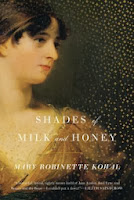
Reading NaNoWriMo: "Shades of Milk and Honey"

http://hip.dubuque.lib.ia.us/ipac20/ipac.jsp?session=1383O8508439L.289&menu=search&aspect=advanced&npp=10&ipp=20&spp=20&profile=cspl-horizon-main&ri=&term=kowal&index=.AW&x=0&y=0&aspect=advanced&term=shades+milk+honey&index=.TW&term=&index=.SW&term=&index=.SE&term=&index=.GW&sort=The bulk of my attention for November has turned to NaNoWriMo, which means less time for reading (even if I'm woefully behind target for my word count). Luckily there are many books that I've enjoyed, but haven't had a chance to review here on the blog, so today I'm here to sell you on the novels of  Mary Robinette Kowal, who happened to write the first of her Glamourist Histories series, Shades of Milk and Honey, during NaNoWriMo.

[Side note: If you're participating in NaNoWriMo this year, we're having a Come Write In session tomorrow (Tuesday) at 6 p.m. and then at 7 p.m. the book club is discussing another NaNoWriMo book, The Night Circus, which Andrew reviewed here.]

I first read Shades of Milk and Honey in 2011, and I picked up the most recent in the series, Without a Summer, this past August. I really enjoy the way Kowal mixes Jane Austen-like Regency romance with a system of magic that fit naturally with the setting. Even better, this has proven to be a series that holds up well to rereads. A fourth book, Valour and Vanity is scheduled for publication next year, and I'll probably be pre-ordering a copy.


In fact, I liked Shades of Milk and Honey so much, that I named it my favorite book of 2011 (I generally try to read at least a few of the Hugo and Nebula nominees each year). Months later I remembered to add a (very) short review to my Goodreads account, and then was floored when Ms. Kowal (or some person in charge of her Goodreads profile) "liked" my review.

It was a helpful reminder that these days it's not uncommon for social media savvy authors to interact with their fans, and not just the fans who sought out their mailing address, email, or blog comment section. It's fairly easy to use keyword tracking to find mentions of your name (especially if a library @ tags the author), or the title of your most recent novel.

In fact, we now have a half-serious joke about trying not to look like we're stalking Rainbow Rowell on Twitter. We aren't. We swear. Though, speaking of, did you know her most recent novel, Fangirl, is also a NaNoWriMo novel?

Of course, it seems unlikely that a group of librarians encouraging readers to love a favorite book as much as we do would be mistaken for creepers. But the other side of an author's ability to connect with fans online, is that it's astonishingly easy for readers to learn about the lives of their favorite authors. Long gone are the days when a young reader might pour over the about the author paragraph in the back of a favorite paperback trying to guess if the author is a cat or a dog person.

For example, we all recently learned how (not so) easy it is to (apply a rigorous research method and) impersonate Patrick Rothfuss on Twitter. In fact, Ms. Kowal applied some of the same methods she used to achieve a writing voice similar to Jane Austen's in order to out Rothfuss Rothfuss (who, it should be noted, failed to hit the 50,000 word mark during NaNoWriMo, and that's okay).

I also learned, in the course of writing this blog post, that Ms. Kowal is an accomplished voice actress, who has narrated several audiobooks. If you'd like to learn more about the author, she keeps a blog on her website: www.maryrobinettekowal.com
She also tweets as herself: @MaryRobinette

~Sarah, Adult Services


One final note: I couldn't think of a way to work in a link to my review of Shine, Shine, Shine by Lydia Netzer, which was also written during NaNoWriMo.

Saturday, November 2, 2013

Mapping Your Story: A Creative Writing Workshop with Dr. Marianne Choquet

If you weren’t able to make the first of our two writing workshops with Dr. Marianne Choquet, don’t fret! We’ve put together a brief overview of the story mapping exercise so that everyone can join us on Wednesday, December 4th at 7 p.m. If you were one of the participants in our first workshop, remember to keep track of your story map and key to bring with you in December. We'll also be providing a microphone for Dr. Choquet's use.

Mapping Your Story: A Creative Writing Workshop
This two-part workshop is for writers with a story to tell who wonder how best to tell it, where to begin, and how to discipline themselves while writing. The idea of mapping a story is to give structure to the writing process. The goal of the workshop is to encourage and focus writers as they create a map and a key of sorts from which to write a first draft.

Dr. Choquet divided the presentation into three parts:
1)    An inspirational overview of the writing process and discussion of her experience writing her first novel.
2)    A guided meditation to calm the mind and allow participants to access the truth of the story within their hearts. (Meditation guide at bottom of this post)
3)    The creation of story maps during which Dr. Choquet answered questions.

The act of storytelling is an act of generosity. You are giving a part of yourself to the people who hear/read your story. Your story will also give back to you as you create it. As Dr. Choquet said, “creativity and generosity thrive together.”

Mapping is an exercise in ownership of space (think of the explorer and cartographer Amerigo Vespucci whose influence led to the naming of the American continents).  By mapping your story you will find that you have a clearer sense of its direction and purpose. The most important thing to remember in the creation of your map is that there is no wrong or right way to create your map.

What you need to create your map:
1)    A place where you can concentrate.
2)    A large piece of paper.
3)    Your choice of pens, markers, pencils, crayons, glitter, etc.
4)    A snack or treat is also fun!

When creating your map, you are discovering the journey of your story, and that journey may take many forms: a map of geographical locations, the shape of an object, a timeline, a web, or anything else that feels right to you.

Questions to ask yourself when creating your map (the key):
1)    Where does your story start?
2)    Where does it end?
3)    What physical locations/points in time are important to your story?
4)    Why do you want to tell this story?
5)    Who do you want to tell this story to?
6)    Who is telling this story? Who is the narrator?
7)    What do you want to give with this story?
8)    What do your characters want?
9)    What do you want this story to do to your reader? To you? To the characters within it?
10)    Imagine the reader finishing your story. What would you like them to say about it?

Most importantly, don’t rush yourself and give yourself the time to really focus. Likewise, don’t overthink. Your first instinct is often your best. This is only the first step on your journey as a storyteller, and there’s always time to change and refine later.

http://carnegiestout.blogspot.com/2013/10/nanowrimo-and-magazines-of-month.html
Follow this link to learn about our other NaNoWriMo events.

Meditation Guide
I always begin with deep belly breathing, in and out through the nose, for at least counts of five, both inhalation and exhalation. This time, Wednesday eve, I brought fire to the belly, imagining a fire glowing there, and steadily, with breath, tending the flame. At a certain point, when it feels time, I tell people to imagine a gold ball (I like to work with gold) spinning at their tailbone. And from there, with timing that feels right all the way through, I guide that ball through the legs to the bottom of the feet, shooting golden roots to the center of the earth, and back up through the body to the crown feeling the golden rays moving out as well as in from above, I especially like to work with gold in the hands and fingers before writing. I eventually guide people to their heart, and to imagine themselves small, standing at the altar of their heart. For this workshop, I then, after some time of guiding people to see their story as they stand there at the altar of the heart, to hear it whispering to them, I tell them to place this story they want to tell on the altar, all of it, in whatever form it comes. I eventually tell them to open their eyes and write where the story begins. To close their eyes, to see it and hear it again, and then to open their eyes and write where it ends. After that, I tell them to fill the page with it. At that point the guided meditation ends and it becomes a meditation in creativity for each person. The overall idea is to feel the energy inside oneself, to feel the connection to earth and ether, to enter one's heart and claim that space as one's own, to feel the electricity in the body and to create with it.

Thursday, October 31, 2013

NaNoWriMo and the Magazines of the Month

It's November once again, which for most people means time to start thinking about holiday gatherings and snow removal, but for some special few of us, November is something more. You might call us crazy, but every number thousands of people band together over the often solitary quest to write an entire novel in one month. That's right, it's time for NaNoWriMo!

In celebration and support of Dubuque's WriMos Carnegie-Stout has arranged a series of speakers, Come Write In sessions, displays of material to help you on your writing journey, and even the magazines of the month fit in the spirit of NaNoWriMo: 


Both Writer’s Digest and The Writer provide resources for writers, from the novice to the established, ranging from advice on publication, networking opportunities, writing prompts, advice and interviews, and more. The Writer began publication in 1887, making it one of the oldest continuously published magazines in the United States. Writer's Digest has been in publication since the 1920s, and is produced by the same publishers as the annual Writer's Market. 

NaNoWriMo Events at Carnegie-Stout

Come Write In!
Tuesdays in November (5th, 12th, 19th, 26th), 6-7 p.m.
Join us in the coffee bar area on the 2nd floor of Carnegie-Stout as we share the fun and frustration of participating in NaNoWriMo. The library will provide a pot of coffee to share, free WiFi, and you can even check out a lap top if you want! Come early, stay late (we're open until 9 p.m. on Tuesdays).

Pathway to Publishing

Sunday, November 17th, 2-3:30 p.m.
Council Bluffs author Marcia Calhoun Forecki will speak about becoming an author.  She has published nonfiction and short stories and contributes to an internet zine and has a blog on Goodreads, a site for readers and book recommendations.  Join Marcia to share your love of stories, books and writing in celebration of NaNoWriMo.

Mapping the Story You Want to Tell

Wednesday, December 4th, 7-8:30 p.m. 
This is the second of two lectures. If you missed the first (on October 30th), you are still more than welcome to join us, as we can also celebrate surviving NaNoWriMo! Dr. Marianne Choquet, a humanities lecturer at UW-Platteville, will direct this two-part workshop for writers with a story to tell and who wonder how best to tell it, where to begin, and how to discipline themselves while writing. The idea of mapping a story is to give structure to the process of writing. The goal of the workshop is to encourage and focus writers and to create a map from which to write a first draft.
 

And if you're registered on the NaNoWriMo website, feel free to add me as a writing buddy: nanowrimo.org/participants/ssmithdbq

~Sarah, Adult Services

Wednesday, October 16, 2013

We Geek Words: Dictionary Day

Today Carnegie-Stout wishes Noah Webster a happy 255th birthday, though we assume that Noah Webster is not an undead monster out there somewhere googling his name. But in case he is, happy birthday!

In Webster's honor, October 16th is known as Dictionary Day. A day to celebrate all things lexicographical, etymological, a dash of the linguistic for good measure. This is the day for every word nerd who's ever spent an hour trying to think of the perfect piece of vocabulary to describe something. Raise your hands if you spent hours memorizing word roots in hopes of making regionals, if not the National Spelling Bee. If you can back your opinion on the use of the word "literally" with research, today is your day.

If you're looking for a way to celebrate, you can check out our Dictionary Day blog post from 2011 for some reading suggestions, or come on down and browse the 400s. We also have DVDs of Akeelah and the Bee and Spellbound available for check out.
There are also a number of great online options for your dictionary based entertainment! Did I miss one of your favorites? Share a link in the comments.

Oxford Dictionaries has a blog with info on word origins, changing slang, and more. It was Oxford Dictionaries Online who shocked a nation by announcing the inclusion of "twerk" shortly after Miley Cyrus's VMA performance.

In response to the scandal of twerking in the (online) dictionary, Mental Floss compiled a list of 16 words from the print edition of the Oxford Dictionary that were once as scandalous as twerk, but are now utterly obscure.

Kory Stamper is a lexicographer at Merriam-Webster, and her blog about life as a lexicographer at Merriam-Webster (Harmless Drudgery) is a source of constant delight. Start here with a post about the headaches of responding to dictionary fan mail and feedback. Stamper also helps to create Merriam-Webster's "Ask the Editor" web video series, an example of which is hopefully embedded below.