During the recent
library haiku contest, I tried to write a poem about how Carnegie-Stout Public Library was here before any of us were born and would likely still be around after all of us have passed away, but I couldn't figure out how to say that within the required number of syllables.
Since then I found an item on eBay which reflects this idea about the permanence of libraries--and the impermanence of library users--as well as any haiku: a 100-year-old Carnegie-Stout postcard.
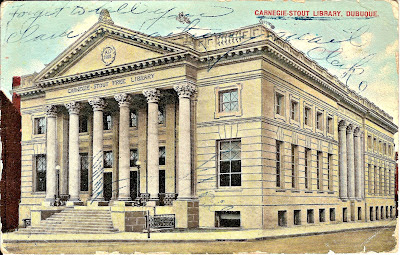 |
| click to enlarge image |
I won the auction for the postcard with a bid of 70 cents, not a bad deal for a beautiful color image of Dubuque's public library from the turn of the century, close to the time when the Carnegie building first opened 1902.
The handwritten note on the back of the postcard is especially interesting. Arthur in Dubuque wrote to Miss Zoe Smith in Webster City, Iowa to say he was a free man now and working for the government and he'd like to come see her.
 |
| click to enlarge image |
I wondered about Arthur's newfound freedom. Did he just get out of jail? Or maybe he had divorced his wife? Would Zoe Smith be eager to see Arthur? Or would she be surprised, or maybe even frightened?
The card is postmarked December 27, 1912, and Arthur's address of 110 Center Place in Dubuque is legible, so I started my research with those bits of information in hopes of learning more about Arthur and Zoe.
Arthur
The 1910-1911 city directory at Carnegie-Stout Public Library shows that Arthur Kline lived at 110 Center Place with Joseph H. Kline, a postal clerk with the Railway Mail Service. Arthur worked at S. P. Wadley Company, a butter and egg wholesaler at 200 South Locust Street.
Joseph H. Kline was Arthur's father, according to the 1910 U.S. Federal Census. Arthur was 17 years old at that time, having been born around 1893. Before moving to Center Place, Arthur lived on Chestnut Street in Dubuque with his mother and father and younger brother and sister.

The Kline's address on the postcard, 110 Center Place, is probably 1132 Center Place today. Some
Dubuque streets were renamed and renumbered during the 1920s. The Klines are listed at 110 Center Place before those changes and at 1132 Center Place afterwards.
When Arthur's father Joseph died in 1926, his funeral services were
held at home at 1132 Center Place. Arthur's mother Addie lived at the same address until she passed away in 1940, and Arthur's brother Russell Kline and his family lived in that house for many more years.
With a tip from Kris Gallagher, Teacher Librarian at
Dubuque Senior High School, I found Arthur's senior portrait in the 1910 yearbook,
The Echo. Arthur attended
Central High School at 15th and Locust Streets. Arthur's full name was Joseph Arthur Kline. He appears to have gone by 'Arthur' until after his father Joseph died in the mid 1920s.
 |
| click to enlarge image |
According to city directories and census records, Arthur's father Joseph was a
railway postal clerk. This helped me figure out the handwriting on the front of Arthur's postcard: "Forgot to tell you I am a railway mail clerk."
So at the end of 1912, Arthur Kline, age 19, had an exciting new job with the government, in the same line of work as his father, which regularly took him at least as far away as Webster City, 167 miles from Dubuque. This must have seemed liberating to Arthur after attending high school, working for a butter and egg wholesaler, and living at home with his younger brother and sister.
I do not know if Arthur ever visited Zoe Smith, but less than two years after he mailed the postcard, Arthur married Mabel Irene Benedict in Fort Dodge, Iowa, about 20 miles west of Webster City. According to Iowa marriage records, Arthur was 22 and Mabel was 20 when they married in 1914.
When Arthur registered for the draft in 1917, he lived in Chicago and was employed by the "U.S. Gov." as a "R.R. Postal Clerk" at the
LaSalle Street Station. At 25, Arthur was tall and medium build, with blue eyes and black hair. Although World War I lasted through 1918, later census records show that Arthur was not a military veteran.
Arthur and Mabel were still in Chicago in 1920. They were both employed as "terminal mail" clerks, and they lived with Mabel's mother Ida Benedict and Mabel's younger brother and sister in a rented house.
By 1930, Arthur and Mabel owned a home worth
$8,500 at 21 Poplar Place in La Grange, Illinois near Chicago. Joseph was still a railroad mail clerk. They lived alone with their 9-year-old son, Robert.
Unfortunately, Arthur passed away a short time later. According to the
Chicago Daily Tribune, Arthur died suddenly on December 2, 1936. He was 44 and was still working as a railroad postal clerk.
Arthur's funeral was held at home at 21 Poplar Place, and he was buried in the La Grange cemetery. He left behind two sons with Mabel, Robert and Joseph.
Zoe
Zoe Smith of Webster City was harder to track down. Zoe, about age 5, appears with her family in the 1900 U.S. Federal Census at 1100 1st Street in Webster City. Zoe's father Nathaniel Smith was a day laborer.
By 1910, Zoe and her family had moved to 1162 10th Street in Des Moines, about 70 miles south of Webster City. At that time, Zoe was 14 years old.
One of Zoe's older sisters, Merle Smith, still lived in Webster City in 1910. Merle owned a millinery shop there until the 1940s. An announcement in the
Webster City Tribune on July 25, 1913 seems to indicate that Zoe Smith spent time there, too: "Misses Merle and Zoe Smith went to Des Moines this morning, where the former goes to buy part of her fall millinery stock."
 |
| click to enlarge image |
I couldn't find much about Zoe Smith after 1913, around the time she was 17 and Arthur sent the postcard to her. Zoe Smith's name does not appear on a list of Webster City school graduates, so either Zoe did not graduate at all or she attended school somewhere else, maybe in Des Moines where she lived in 1910.
Oddly, a 'Zoe Smith' is mentioned in
Bert Leston Taylor's humor column "A Line-O'-Type or Two" in the
Chicago Daily Tribune on October 18, 1912: "LYLE BLACK and Zoe Smith were married in Liscomb, Ia., the other day, and no one thought to play the anvil chorus."
 |
| click to enlarge image |
Iowa marriage records show that a 'Lyle J. Black' was born in Webster City in 1895, but he went on to marry Ruth Casler in 1920. I couldn't find any other records to verify that Zoe Smith married Lyle Black, so perhaps the blurb in the Chicago column was a joke or just a strange coincidence.
Since I was stuck, I sent an email asking for help to Reference Librarian Ketta Lubberstedt-Arjes at
Kendall Young Library in Webster City. Ketta replied with a copy of pages from a Webster City funeral home index which show that Merle E. Kellogg (nee Smith) died in 1967, and that Merle's sister Mrs. Zoe Herbel lived at 188 East 19th Street in Costa Mesa, California.
With Zoe's married name, I found her in the 1930 census in Los Angeles living with her husband, Earl L. Herbel. Zoe G. Herbel, 31 years old, was a saleswoman at a drygoods store. Earl, age 25, was a repairman at an auto repair garage. Like Zoe, Earl was originally from Iowa. They were married in Los Angeles around March 1926, according to an announcement in the
Adams County Free Press of Corning, Iowa.
Zoe Gladys Herbel died on February 6, 1972 in Huntington Beach, California, and she was
buried in Glendale, California, almost 60 years after Arthur sent the postcard to her.
Resources
Most of the information above came from
Ancestry Library Edition, a genealogy database accessible at Carnegie-Stout Public Library. I looked at other library databases, too, including
HeritageQuest Online,
NewsBank, and
ProQuest Historical Newspapers. And I checked old city directories and the card index of obituaries at Carnegie-Stout.
Some online sites were useful, like
Encyclopedia Dubuque,
FamilySearch.org,
IAGenWeb,
Google News Archive,
NewspaperARCHIVE.com, and
THOnline.com's Obituary Archive.
Ketta Lubberstedt-Arjes, Reference Librarian at
Kendall Young Library in Webster City, Iowa, and Kris Gallagher, Teacher Librarian at
Dubuque Senior High School, were both very helpful.
These resources can't tell us how Arthur knew Zoe, why Arthur chose a Carnegie-Stout Public Library postcard to send, or if Zoe ever received the card and responded. But they can provide a little context to help us better understand people, like Arthur and Zoe, who lived before us.
Michael May
Adult Services Librarian
Carnegie-Stout Public Library
 This week's #1 book on the fiction bestsellers list is again 11th Hour by James Patterson & Maxine Paetro (you can find read-alikes for that book here) At number 2 is John Sanford's Stolen Prey. Sandford's latest is the 22nd installment in his Prey series, featuring Lucas Davenport (now an agent with the Minnesota Bureau of Criminal Apprehension.) In this entry, Davenport investigates a particularly gruesome crime - the torture and murder of an entire family in an small, upscale neighborhood. The killings have all the markers of a drug cartel, and investigators soon uncover a cross-border money laundering scheme. As Davenport unravels the mystery, he's pulled deeper, leading him to dark places and putting his own life at risk.
 This week's #1 nonfiction book is Colin Powell's It Worked for Me: In Life and Leadership. More of a meditation on leadership than a memoir, the book collects lessons and personal anecdotes that have shaped the four-star general and former Secretary of State's career in public service, and offers advice for succeeding in the workplace and life.


